
In the ER, X-ray, CT and ultrasound images are usually taken and reviewed during your visit, and the emergency physician uses them to guide your care before you leave. A radiologist then writes and signs the final report, which can arrive after you go home. The scan itself is often the short part: a bone X-ray is usually done within five to 10 minutes, and a complete CT scan most often takes only a few minutes. Contrast, extra views and the radiologist’s read are what add time.
Below: each test, who reads it, preliminary versus final reports, and getting copies. For the whole visit from check-in to discharge, see how long an ER visit takes.
How Long Do X-Ray Results Take in the ER?
MedlinePlus explains that dense structures such as bone block most of the X-ray and show up white. RadiologyInfo.org (American College of Radiology and RSNA) says two or three images from different angles are typically taken, and a bone X-ray is usually completed within five to 10 minutes. A picture of the uninjured limb, or of a child’s growth plate, may be added for comparison. The technologist may ask you to wait until the radiologist confirms all the needed images are there.
Hold still; motion blurs the image. Some fractures are too fine to show on the first X-ray, as our guide on telling a sprain from a fracture explains.
How Long Do CT Scan Results Take in the ER?
A CT (computed tomography) scan uses X-rays to create pictures of cross-sections of the body. MedlinePlus says complete scans most often take only a few minutes, and the newest scanners can image the entire body in less than 30 seconds.
CT without contrast goes straight to the scanner. A head CT after a fall is a common example; see when to go to the ER after hitting your head.
CT with contrast has extra steps. Contrast is a special dye that helps certain areas show up better. MedlinePlus says it may go through an IV in your hand or forearm, or you might drink it, and when you drink it depends on the type of exam. IV contrast can worsen kidney function, and people taking the diabetes medicine metformin may need to stop it for a while. Tell the team about kidney problems, metformin, or a past reaction to contrast.
How Long Do Ultrasound Results Take in the ER?
Ultrasound uses sound waves, not radiation. MedlinePlus describes a clear gel on the skin and a handheld probe called a transducer moved over the area. You may need to change position, and preparation depends on the body part being examined.
RadiologyInfo.org notes that ultrasound provides real-time imaging. A radiologist analyzes the images and sends a signed report, and in some cases the radiologist may discuss results with you after the exam.
Who Reads Your Images in the ER?
A radiologist, a doctor trained to supervise and interpret radiology exams, analyzes the images and sends a signed report to the doctor who requested the exam, according to RadiologyInfo.org. In the ER, the emergency physician who ordered the scan usually looks at the images too, so treatment can start while the formal report is being written.
What Is the Difference Between a Preliminary Read and the Final Report?
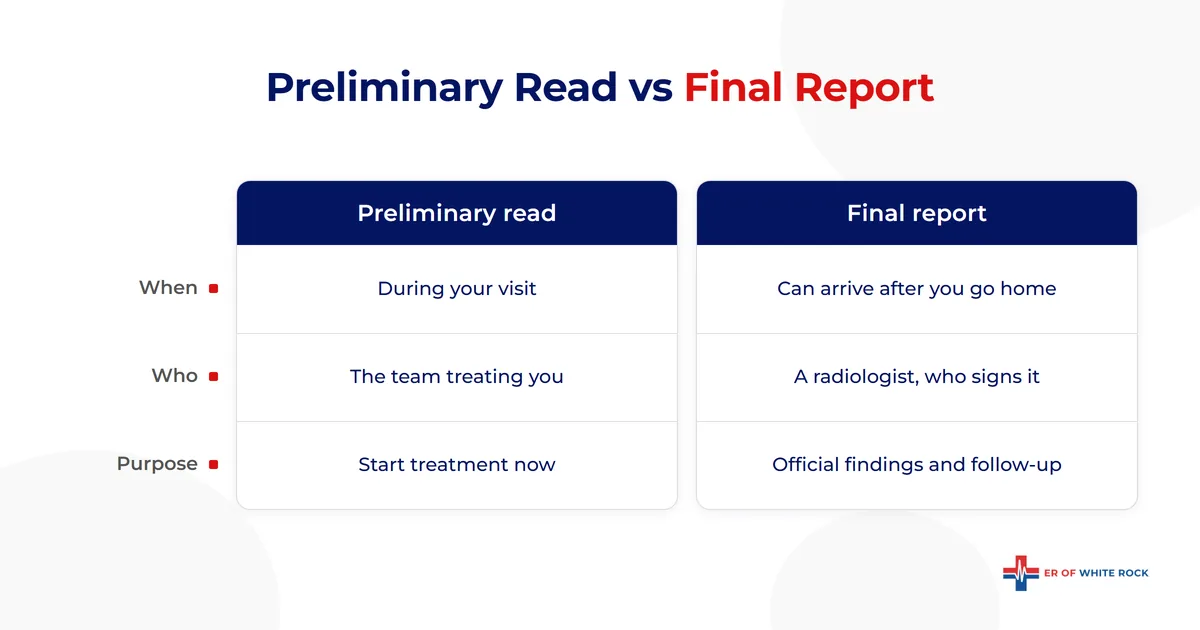
The preliminary read is the first interpretation, made so the team can act. Radiology Today explains that preliminary reports can be delivered faster, and in emergency settings, time to treatment can be crucial.
The final report is the radiologist’s signed, official document. According to RadiologyInfo.org, it lists earlier exams used for comparison, describes the findings, and ends with an impression: the most important findings plus any follow-up recommendations.
If the ER calls after your visit, answer. It may be about your final report.
What Can Make Imaging Results Take Longer?
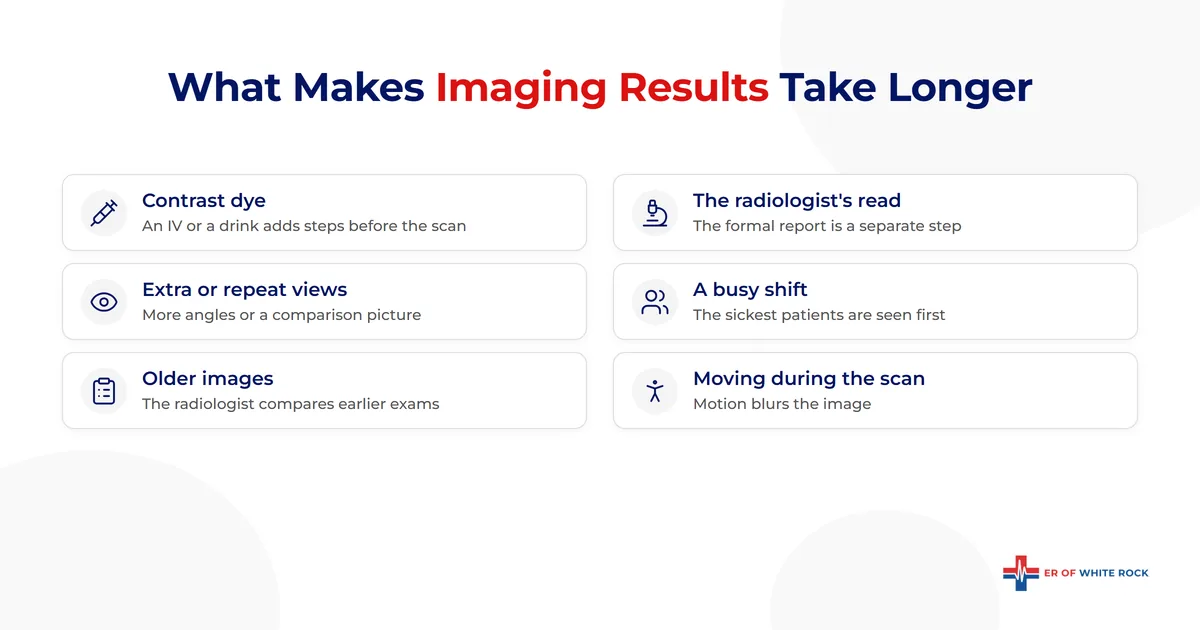
- Contrast. An IV, or drinking contrast on the schedule the exam needs, adds steps before the scan.
- Extra or repeat views. More angles, a comparison picture, or a wait while the radiologist confirms the images are complete.
- Comparison with old images. RadiologyInfo.org says having older exams can be very helpful to the radiologist, so say where earlier scans were done.
- The radiologist’s read. The formal report is a separate step after the pictures are taken.
- A busy shift. ERs treat the sickest patients first, so a critical arrival can move ahead of a routine scan.
How Do You Get Your Imaging Results and Images After the ER?
RadiologyInfo.org says many patients can now see most radiology reports online right away, so you may see the report before your doctor has a chance to review it. It is written for doctors, so discuss it with one.
HealthIT.gov, from the U.S. Department of Health and Human Services, suggests:
- Check the provider’s patient portal first, if it has one.
- Otherwise, ask for the health information services department or the staff who release health records.
- Ask about delivery. Options can include a CD or USB drive, a portal, a health app, mail, or in-person pickup.
- Under the HIPAA Privacy Rule, a provider can take up to 30 days. Electronic copies will likely be free; a reasonable fee may apply for making or mailing copies.
Before you leave the ER, ask how to get your imaging report and images, and share them with your own doctor.
What Happens With Imaging at ER of White Rock?
ER of White Rock has on-site CT, digital X-ray, ultrasound, ECG and a full laboratory. The medical team decides whether CT, X-ray or ultrasound fits your symptoms; our diagnostic imaging services page has more detail. CT and X-ray images are usually taken within 20 minutes of the order, with the radiologist read following soon after, and most diagnostic answers come back in 30 to 60 minutes. Most blood tests take 15 to 30 minutes (see our guide to ER lab testing). Your physician reviews the results with you before you go home.
If you need hospital admission or a specialist, we stabilize you and arrange the transfer, and your workup travels with you. Before a scan, mention any chance of pregnancy, kidney problems, and where earlier scans were done.
We are open 24/7, including holidays, at 10705 Northwest Hwy, Dallas, TX 75238, near White Rock Lake, Lake Highlands, Casa View, Lakewood, Forest Hills, East Dallas and Garland. Walk in, no appointment needed; patients are seen in under 10 minutes. Call (469) 943-2939.
FAQs
How long does it take to get X-ray results in the ER?
The X-ray usually takes five to 10 minutes. The emergency physician typically reviews it during your visit; the radiologist’s signed report can follow later.
How long do ultrasound results take in the ER?
There is no single standard time. Ultrasound provides real-time imaging, and a radiologist then sends a signed report.
Do you get CT scan results the same day in the ER?
Usually you get a working answer before you leave. The final signed report can come later, sometimes in a patient portal first.
Does a CT scan with contrast take longer?
Usually, yes. Contrast is given by IV or by mouth first, and the team needs to know about kidney problems, metformin, or past contrast reactions.
Can I get a copy of my ER X-ray or CT scan?
Yes. HealthIT.gov lists test results and X-rays among the records you can request. Ask the ER how; under the HIPAA Privacy Rule a provider can take up to 30 days.