The moment you or a loved one walks into an emergency room with chest pain, a high fever, or sudden weakness, the clock starts ticking. In these high-stakes moments, “wait and see” isn’t an option.
In the past, patients often faced a “waiting game” while their blood samples were sent to off-site laboratories miles away. Today, emergency lab testing in White Rock, TX, has been transformed by on-site diagnostics.
Having a full-service lab just steps away from the exam room allows doctors to move from “searching for answers” to “starting treatment” in a fraction of the time.
How Long Do Blood Tests Take in the ER?
At ER of White Rock, most blood test results come back in 15 to 30 minutes. Every test runs in our on-site lab, so no sample waits on a courier. Priority tests, like troponin for chest pain, are often resulted within 20 minutes of the blood draw.
| Test | What it checks | Typical on-site turnaround |
|---|---|---|
| Complete blood count (CBC) | Infection, anemia, blood disorders | 15 to 20 minutes |
| Metabolic panel | Kidney function, liver, electrolytes | 15 to 30 minutes |
| Troponin (cardiac enzyme) | Heart attack | 15 to 20 minutes, prioritized |
| Urinalysis | Infection, dehydration, kidney stones | 15 to 20 minutes |
| Rapid strep, flu, COVID-19 | Respiratory infections | 15 to 25 minutes |
| D-dimer | Blood clots | 20 to 30 minutes |
These times reflect our on-site turnaround. A small number of specialized tests still go to a reference lab and can take longer. Your care team will tell you which results are back before you leave and which will follow.
The Role of Laboratory Testing in Emergency Medicine
In emergency medicine, information is the most valuable tool a doctor has. According to the CDC, a correct and timely diagnosis is the foundation of effective treatment.
Laboratory testing provides the objective data, the “evidence” inside your body that confirms what a physical exam can only suggest.
Why Minutes Matter for Bloodwork and Fluid Analysis
In a crisis, time is literally life. For conditions like sepsis or a heart attack, a delay of even a few minutes can significantly impact a patient’s recovery.
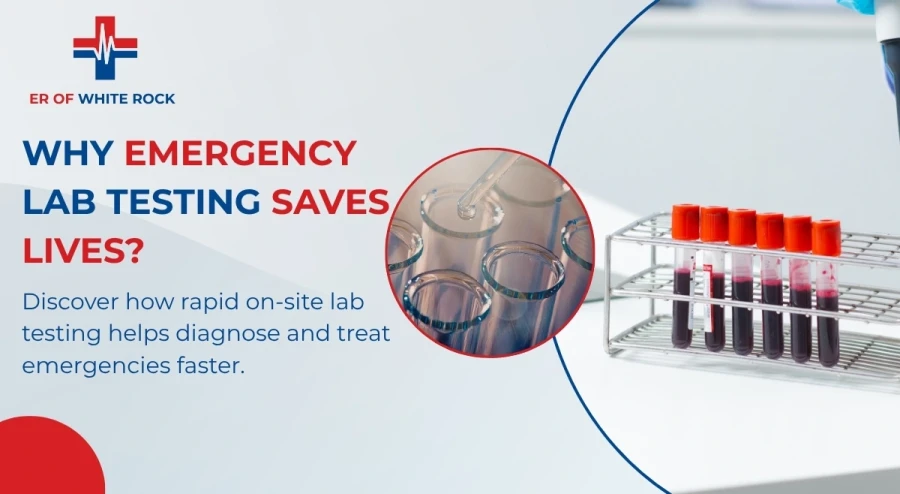
On-site labs eliminate the “transportation gap,” where samples sit in a courier’s vehicle instead of being analyzed. By using Point-of-Care Testing (POCT), ER physicians can receive critical results in as little as 15 to 20 minutes, allowing them to stabilize patients faster and reduce the total length of the hospital stay.
Common Emergency Lab Tests We Perform On-Site
When you visit our facility for emergency lab testing in White Rock, TX, you aren’t just getting a simple blood draw. You are accessing a sophisticated suite of diagnostic tools designed to catch serious issues early.
Complete Blood Count (CBC) and Comprehensive Metabolic Panels
According to MedlinePlus, a Complete Blood Count (CBC) is one of the most versatile tests in an ER. It measures your red and white blood cells to check for anemia or signs of a hidden infection.
Paired with a metabolic panel, which checks your kidney function, liver health, and electrolyte levels (like sodium and potassium), these tests give your doctor a “roadmap” of your internal health within minutes of your arrival.
Cardiac Enzyme Tests (Troponin) for Heart Attacks
MedlinePlus states that for patients with chest pain, the Troponin test is the gold standard. Troponin is a protein released into the blood stream only when the heart muscle is damaged.
Because every minute matters during a heart attack, our on-site lab prioritizes these results. Modern high-sensitivity troponin assays allow us to “rule in” or “rule out” a heart attack with incredible precision, often before other symptoms even appear.
Urinalysis and Infection Screenings
Urinalysis is more than just a check for a UTI. According to MedlinePlus, in an emergency setting, urinalysis can reveal dehydration, kidney stones, or even early signs of sepsis, a life-threatening response to infection.
Quick screening helps us determine if a patient needs immediate IV antibiotics or further imaging. For scan timing, see how long X-ray, CT and ultrasound results take in the ER.
Rapid Strep, Flu, and COVID-19 Testing
Respiratory symptoms can be confusing. Is it a common cold, or something that requires isolation? Our on-site rapid molecular tests can differentiate between Strep A, Influenza, and COVID-19 while you wait.
This prevents the spread of illness and ensures you walk out with the right prescription for your specific virus or bacteria.
Urgent Care vs. Freestanding ER: The Lab Difference
Many patients wonder why they should choose a freestanding ER over a standard urgent care clinic. The answer often lies in the laboratory.
- Urgent Care: Typically equipped for basic tests (like rapid strep or pregnancy tests) but often sends complex bloodwork to outside labs, leading to a 24-48 hour wait for results.
- Freestanding ER: Provides hospital-level diagnostics 24/7. This includes advanced testing for blood clots (D-dimer), cardiac markers, and arterial blood gases that urgent cares simply cannot perform.
How Advanced Diagnostics Lead to Better Patient Outcomes
The goal of emergency lab testing in White Rock, TX, is not just to provide data; it’s to provide peace of mind and better health. When we have results in hand within the first hour of your visit:
- Treatment starts sooner: Whether it’s the right antibiotic for sepsis or a life-saving blood thinner.
- Less uncertainty: Patients and families don’t have to spend hours or days wondering what is wrong.
- Safer transitions: If a patient needs to be transferred to a major hospital for surgery, they arrive with a completed diagnostic file, meaning the surgeons can get to work immediately.
Emergency Lab Testing in White Rock, TX
We understand that an ER visit is a stressful time. ER of White Rock facility runs its lab on site, so most results come back during your visit.
Visit the ER of White Rock now for fast relief and expert care.
Need Immediate Care? Call Us Now at (469) 943-2939
Stay informed with seasonal health tips, first-aid advice, and practical ways to maintain your well-being year-round. Follow ER of White Rock on Facebook and Instagram for valuable health updates.
FAQs
How long does a typical ER lab test take?
Most of our on-site tests, including CBCs and metabolic panels, provide results in 15 to 30 minutes. More specialized tests, like those for heart enzymes, are prioritized to ensure the fastest possible turnaround.
Why do I need a blood test if I only have a stomachache?
Abdominal pain can be caused by many things, from minor indigestion to a serious gallbladder issue or appendicitis. Blood tests help us look for elevated white blood cell counts or liver enzymes that point toward the true cause of your pain.
Do you perform COVID-19 and Flu testing on-site?
Yes. We offer rapid molecular testing that provides results during your visit, allowing us to provide immediate treatment or guidance on isolation.
Can I get my lab results sent to my primary doctor?
Absolutely. We believe in “continuum of care.” Once your emergency visit is complete, we can provide you with a digital or paper copy of your results to share with your regular physician for follow-up.
What is a “Troponin” test, and why is it important?
Troponin is a protein found in the heart muscle. If your heart is under stress or damaged (as in a heart attack), this protein leaks into your blood. Finding it quickly is crucial for diagnosing and treating a heart attack in its earliest stages.