Go to the ER for an asthma attack if your quick-relief (rescue) inhaler does not help, or if your symptoms do not go away soon after you use it. Call 911 instead if it is hard to walk or talk, your lips or fingernails look blue or gray, or you are confused or less alert than usual.
This guide covers the warning signs, how the zones on an asthma action plan tell you when to go, the signs to watch for in a child, and what happens when you arrive at ER of White Rock.
When Should You Go to the ER for an Asthma Attack?
The National Heart, Lung, and Blood Institute (NHLBI) says to go to the emergency room if your symptoms do not go away soon after you take your at-home medicines, or if you have a serious asthma attack. It says to call 911 if your medicines are not relieving your symptoms during an attack or if breathing is still very hard.
Not every flare-up needs the ER. NHLBI notes that you may be able to manage one with just your reliever inhaler, used as soon as symptoms start. What matters is what happens next: an inhaler that does not help, or symptoms that keep getting worse, mean it is time for emergency care.
What Are the Signs of a Severe Asthma Attack?
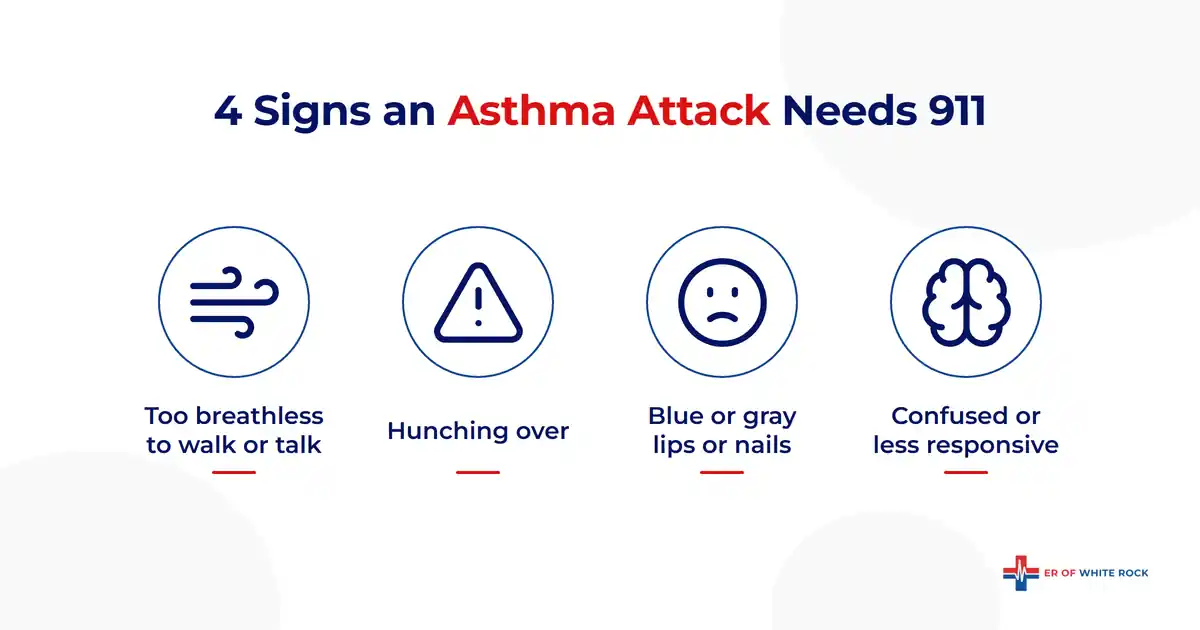
MedlinePlus lists these danger signs. Call 911 right away if you or someone with you has any of them:
- Trouble walking or talking because it is so hard to breathe
- Hunching over
- Lips or fingernails that are blue or gray
- Confusion, or being less responsive than usual
MedlinePlus also describes what very hard breathing can look like: the skin of the chest and neck may suck inward with each breath. Other symptoms of an attack include coughing, wheezing, chest tightness, and breathing faster than normal.
If any danger sign is present, call 911 rather than driving yourself.
What If Your Rescue Inhaler Is Not Working?
A rescue inhaler that does not relieve an attack is one of the clearest reasons to get help now. NHLBI says to call 911 if your medicines are not relieving your symptoms during an asthma attack or if breathing is still very hard.
Needing your reliever more often is a warning sign too. NHLBI lists using more than one canister of a short-acting reliever medicine (SABA) each month as a reason to seek care right away when symptoms start.
How Do Asthma Action Plan Zones Tell You When to Go?
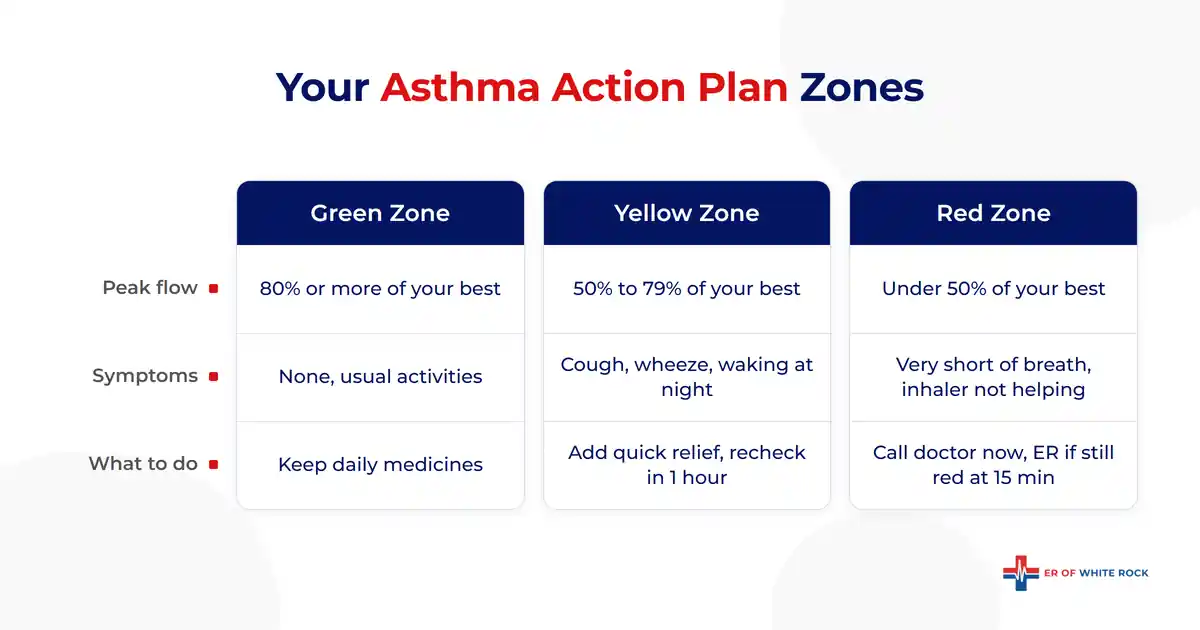
An asthma action plan is a written plan from your doctor that says what to do as symptoms change. The NHLBI asthma action plan (December 2020) sorts symptoms into three zones. If you use a peak flow meter, each zone also matches a share of your personal best peak flow.
| Zone | Peak flow | What it looks like | What the plan says to do |
|---|---|---|---|
| Green: doing well | 80% or more of your best | No cough, wheeze, chest tightness, or shortness of breath, day or night. You can do your usual activities. | Keep taking your daily medicines. |
| Yellow: getting worse | 50% to 79% of your best | Cough, wheeze, chest tightness, or shortness of breath, waking at night, or doing only some of your usual activities. | Add quick-relief medicine. If you are not back in the green zone after 1 hour, follow the next steps your doctor wrote in your plan. |
| Red: medical alert | Less than 50% of your best | Very short of breath, quick-relief medicine has not helped, you cannot do usual activities, or symptoms are the same or worse after 24 hours in the yellow zone. | Take the medicines your plan lists and call your doctor now. Go to the hospital or call an ambulance if you are still in the red zone after 15 minutes and have not reached your doctor. |
The same plan lists two danger signs that skip the waiting: trouble walking and talking because of shortness of breath, or lips or fingernails that are blue. For either one, it says to take your quick-relief medicine and go to the hospital or call an ambulance now.
The medicines and doses on your plan come from your own doctor, so follow your plan rather than a general chart. If you do not have a written plan yet, ask for one at your next visit.
When Should a Child With Asthma Go to the ER?
NHLBI says to call 911 for a young child with asthma who:
- Seems drowsy, confused, or troubled
- Has a blue tint to the skin and lips
- Has a fast heartbeat
The MedlinePlus danger signs apply to children as well. MedlinePlus says everyone who cares for a child with asthma, including teachers and babysitters, should know to call 911 if those signs appear.
Our parent’s guide to pediatric emergencies covers other breathing problems in children, such as croup and RSV. Our pediatric emergency care is available 24/7.
Who Is at Higher Risk of a Serious Asthma Attack?
NHLBI says you should seek care right away if you or your child have symptoms and any of these apply:
- You were hospitalized for asthma in the past year, or have had life-threatening attacks before
- You recently needed corticosteroids taken by mouth for asthma
- You have not been using inhaled corticosteroids
- You use more than one canister of a short-acting reliever medicine each month
- You have a mental health condition or an alcohol or drug use disorder
- You do not closely follow your asthma action plan
- You have a food allergy
If one of these describes you, treat a flare-up as more urgent than you might otherwise.
How Common Are Asthma ER Visits in Texas and Dallas County?
The Texas Department of State Health Services Impact of Asthma in Texas 2025 Report found that uncontrolled asthma contributed to more than 109,000 emergency department visits and 8,500 hospitalizations in Texas in 2023. More than 2.2 million adults and children in Texas have asthma.
The same report found that asthma ER visits generally peak in April, October, and December. If your asthma tends to flare in the fall or around the holidays, keep your action plan and quick-relief inhaler close this season.
Dallas County is in DSHS Public Health Region 3. In 2023, asthma ER visit rates in Region 3 were significantly higher than the statewide rates for both adults (28.4 visits per 10,000 adults, age-adjusted) and children (64.0 per 10,000 children).
What Happens at the ER for an Asthma Attack?
NHLBI explains that in the emergency room you may receive medicine through a nebulizer, a small machine that turns liquid medicine into a mist you breathe in, or through an IV line in your arm. In severe cases, you may also need oxygen therapy or a ventilator to help you breathe.
At ER of White Rock, our emergency care for breathing problems includes oxygen therapy, on-site nebulizer treatment for asthma attacks, medicines to reduce airway inflammation, CPAP and BiPAP, and intubation for a patient who cannot breathe on their own. CT, X-ray, and full laboratory services are also on site.
We are open 24 hours a day, every day, at 10705 Northwest Highway, and patients are seen in under 10 minutes. If you can, bring your inhalers and a list of your medicines. Our guide on what to tell the ER team explains what helps, but never delay care to gather it.
FAQs
Is an asthma attack an emergency?
It can be. NHLBI says asthma attacks can come on quickly or gradually and may be life-threatening. Call 911 for any of the danger signs above.
Should I go to urgent care or the ER for an asthma attack?
Go to the ER if your rescue inhaler is not helping or your symptoms do not go away soon after you use it. Call 911 if breathing is still very hard or you have a danger sign. For a mild flare-up that responds to your reliever, follow your action plan and call your doctor.
Can I drive myself to the ER during an asthma attack?
No, not if you have trouble talking or walking, blue or gray lips, or confusion. Call 911.
What does an asthma attack feel like?
NHLBI says that for some people, an attack starts with coughing. Your chest may feel tight, like someone is sitting on it, and some people say it feels like breathing through a straw. You may start to wheeze or feel lightheaded.
Should I call my doctor after an asthma attack I treated at home?
Yes, if your medicines did not relieve the attack or your peak flow number is low. NHLBI lists both as reasons to call your provider.