On an ordinary Tuesday afternoon, you notice a strange, dull ache in your calf. You might brush it off as a cramp or soreness from yesterday’s walk. But as the hours go on, the area feels warm to the touch and the skin looks faintly reddened.
In moments like these, knowing how to tell a minor strain from a potentially deadly blood clot can save your life. Our ER treats patients worried about these “silent threats” every day.
Our goal is to give you the clear information and the fast care you need to breathe easy again. For the broader cardiovascular picture, our cardiovascular emergencies guide covers heart attack, stroke, and blood clots together.
What Is a Blood Clot and Why Are They Dangerous?
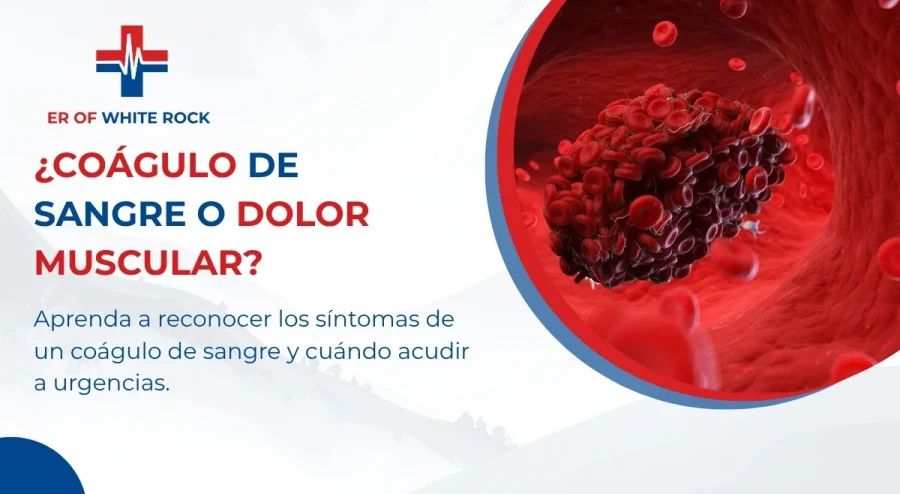
A blood clot, or thrombus, is a collection of blood that has shifted from a liquid state to a gel-like state. Clotting is a normal response when you cut yourself and bleeding needs to stop. Clots that form inside veins without an injury, however, are dangerous.
The Centers for Disease Control and Prevention report that as many as 900,000 Americans are affected by blood clots every year.
The National Institutes of Health note that the danger depends on where a clot forms and where it travels. When a clot forms in the deep veins of the body, usually the leg, it is called deep vein thrombosis (DVT).
The “silent” part is real: nearly 50 percent of people with a DVT have no symptoms at all. If a DVT is left untreated, a piece of the clot can break off and travel to the lungs, causing a potentially fatal blockage.
How to Recognize Deep Vein Thrombosis (DVT)
DVT is the most common starting point for serious clotting problems. Because the deep veins sit far below the surface, you cannot actually “see” the clot, but you can spot the secondary signs in the affected limb.
Swelling, Unexplained Pain, and Redness in a Leg or Arm
The classic DVT signs almost always appear in a single limb, not both. If you notice any of the following, get medical attention immediately:
- Swelling: the leg or arm may suddenly look puffy or noticeably larger than the other side. This is often most obvious around the ankle or calf.
- Unexplained pain: often feels like a stubborn cramp, a deep ache, or a “pulled muscle” that does not improve with rest or elevation.
- Skin changes: the area may feel warm to the touch or look reddened or bluish.
The Deadly Progression: Pulmonary Embolism (PE)
When a DVT is missed or ignored, it can lead to a pulmonary embolism (PE). This is what happens when the clot breaks loose, travels through the bloodstream, and lodges in the arteries of the lungs.
A PE is a true medical emergency where every second counts.
Sudden Shortness of Breath and Sharp Chest Pain
The most common symptom of a pulmonary embolism is sudden shortness of breath. It can feel as though you just ran a marathon while sitting still.
That symptom is often paired with a sharp, stabbing chest pain that gets worse with a deep breath or a cough.
Coughing Up Blood
In severe cases, a pulmonary embolism can cause a persistent cough. If you cough up mucus streaked with blood or pink, frothy sputum, the blockage is causing significant lung distress.
Who Is at Higher Risk for Blood Clots?
Blood clots do not discriminate, but certain factors act as fuel for their formation. Understanding your risk profile is the first step toward prevention.
Recent Surgery, Long Travel, and Medication-Related Factors
- Recent surgery: the NIH notes that major procedures, especially orthopedic hip or knee surgery, significantly raise the risk because of prolonged immobility and blood vessel trauma.
- Long travel: the CDC notes that sitting for more than 4 hours in a car or on a plane causes blood to pool in the lower legs. That is why doctors recommend flexing the ankles and walking around often during travel.
- Medications: estrogen-based therapies including birth control pills and hormone replacement therapy (HRT) can increase the blood’s natural tendency to clot.
- Other risk factors: active cancer, pregnancy and the weeks after delivery, a personal or family history of clotting disorders, obesity, smoking, increasing age, and a recent major illness like COVID-19.
How Blood Clots Are Diagnosed in the ER (D-dimer and Ultrasound)
If you come to a blood clot emergency room near White Rock Lake, your medical team will work quickly to confirm or rule out a clot.
- D-dimer test: a simple blood test that measures a protein fragment produced when a clot breaks down. According to MedlinePlus, a negative D-dimer result usually means a clot is unlikely, helping doctors rule it out quickly.
- Duplex ultrasound: the reference-standard test for DVT. It uses sound waves to create a real-time image of blood flow and can pinpoint the exact location of an obstruction.
- CT pulmonary angiogram: if pulmonary embolism is suspected, this scan visualizes the pulmonary arteries to find or rule out a clot.
Our in-house clinical lab turns around D-dimer results in under 30 minutes, and our on-site CT and ultrasound suite can complete the imaging within an hour of arrival.
The Best Emergency Room for Blood Clots in East Dallas
Whether you are dealing with localized leg pain or sudden shortness of breath, the ER of White Rock is equipped to provide life-saving care 24 hours a day, 7 days a week. We specialize in rapid D-dimer testing and immediate ultrasound to give you answers when you need them most.
Treatment starts with anticoagulation, typically a heparin drip transitioned to an oral blood thinner. Our blood clot treatment page covers the full workup and stabilize-and-transfer pathway for massive clots that need a higher level of care. For the broader ER choice question, our freestanding ER vs hospital ER guide walks through the decision.
Visit ER of White Rock now for fast relief and expert care.
Need immediate care? Call us now at (469) 943-2939.
Stay informed with seasonal health tips, first-aid advice, and practical ways to maintain your well-being year-round. Follow ER of White Rock on Facebook and Instagram for valuable health updates.
Frequently Asked Questions
Can a blood clot go away on its own?
While the body can sometimes dissolve very small clots over time, you should never assume a clot will disappear. A DVT can break loose at any moment, which is why medical evaluation is critical.
Does a blood clot always hurt?
No. About half of people with a DVT have no symptoms at all. That is why knowing the risk factors (recent surgery, long travel, etc.) matters so much.
What does pain from a blood clot feel like?
It is usually described as a dull, persistent ache or a feeling of heaviness in the calf or thigh. Unlike a typical muscle cramp, it generally does not improve with stretching or massage.
Is it safe to massage a leg if I suspect a clot?
No. If you suspect a blood clot, do not massage the area. Massaging can accidentally dislodge the clot and send it traveling to the lungs (pulmonary embolism).
How quickly can a blood clot become dangerous?
A DVT can progress to a pulmonary embolism very quickly, sometimes within hours or days of the first symptoms appearing.